
GPP to yield theory
Biomass is produced as a result of the photosynthesis process. This process depends on light and environment (remember the light use efficiency model, LUE, from the previous topic), it is very dynamic (every second different) thus our estimates of photosynthetic rate are instantaneous. What we mean by photosynthesis or gross primary productivity (GPP) is the rate of CO2 absorption by plants. Every carbon atom absorbed from the air becomes a carbon atom in an organic molecule (protein, carbohydrate, lipid, amino acid).
Plants respire as well as we do; they burn down sugars to produce energy and emit CO2. This loss of absorbed carbon is taken into account in net photosynthesis or net primary productivity (NPP) is GPP minus autotrophic respiration (AR).
In the course of growing season plants accumulate carbon in various organic compounds. Biomass is the total weight of plant components. However, yield is only a part of plant biomass, part of belowground biomass for potato (tubers) or part of aboveground biomass for wheat (ear).
In order to convert GPP to yield we have to follow three steps:
- Subtract respiration from GPP to make it NPP [already done in WaPOR products]
- Aggregate NPP over the growing season to biomass
- Partition biomass into yield and other plant parts
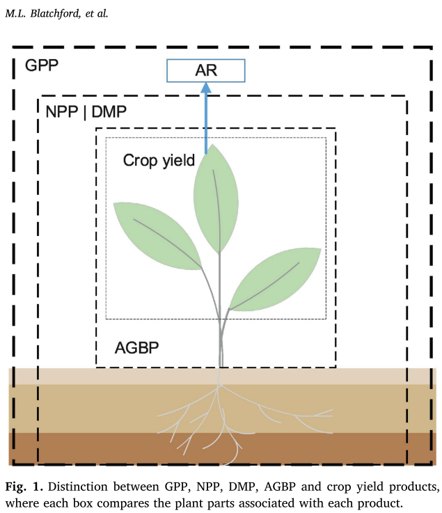
Figure from Blatchford et al., 2019
| quantile | meaning | units |
|---|---|---|
| GPP | Gross primary productivity | |
| AR | Autotrophic (plant) respiration | |
| NPP | Net primary productivity | |
| DMP | Dry matter productivity | kg DM ha |
| AGBP | Aboveground biomass productivity | kg DM ha |
| yield | Crop yield | kg FW ha |
Advanced clarification:
The aggregation period can be easily deducted from remote sensing EO imagery (see Topic 3 Phenology). The values of partitioning coefficients (harvest index, above-ground biomass fraction) are tabulated for many crops. Crop type might also be deducted from EO imagery, however, ground data for calibration of the crop type classification algorithm is needed. Here for the first time we encounter a limitation of remote sensing, we can not compute CWP without engaging farm managers, from whom we need at least crop-type data.
Reading task:
Please, go through sub-section 2.1.3 Harvest Index (raw pdf pp 27-30, document pp 15-18 document) of the WaPOR v2 methodology where harvest index adjustments are described, along with tabulated values for some crops.
Take a look at Figure 8 (raw pdf p 42, document p 30) where GPP to NPP to DMP is explained.
Find the productivity to yield conversion equations 3 (raw pdf p 25, document p 13) and 4 (raw pdf p 26, document p 14).
Answer the following questions:
- What are the AGBF and moisture content symbols used in the manual equations 3 and 4?
- Does the manual contain any further explanation on them?
- Which environmental factor is used to adjust the initial harvest index?