
CWP and EO: E,T with PM
WaPOR uses a two-source Penman-Monteith equation:
- the first source is soil evaporation (E)
- the second source is vegetation transpiration (T)
The final product also includes "interception" (I) which is water that remains on a plant after rain and evaporates immediately from plant surfaces (leaves, stems), without getting into the soil.
Total ET = E + T + I.
For the computation of CWP, we use ETa, provided by WaPOR in the actual evaporation, transpiration and interception (AETI) product.
Reference crop evapotranspiration (RET)
In addition to AETI, WaPOR also provides reference crop evapotranspiration (ETo, RET) products at 10-km resolution. This can create a bit of confusion, as it refers back to the FAO Irrigation and Drainage paper 56 published in 1998. This methodology also uses the Penman-Monteith method but single-source.
- Reference crop evapotranspiration, ETo, RET, ETr, ETref, REF. It reflects the effect of the environment and shows how much would a reference crop (12-cm-tall, well-watered grass) evaporate in the given climatic conditions. The computations are done with the Penman-Monteith equation.
- Potential evapotranspiration, ETp, PET (outdated term ETc). ETo corrected for a specific crop (wheat, maize, barley etc.) with the help of crop coefficient (Kc). The assumptions that still hold are:
- well-watered conditions (no stress from soil)
- healthy crop (no stress from diseases, nutrients etc.)
- Actual evapotranspiration, ETa, AET (outdated term ETcadj). The true amount of water that was evaporated and transpired by soil and crop.
The first two ET types (ETo, ETp) are theoretical, computed from weather and crop data, ETa is practical, i.e. not only computed by a model but can also be measured in the field.
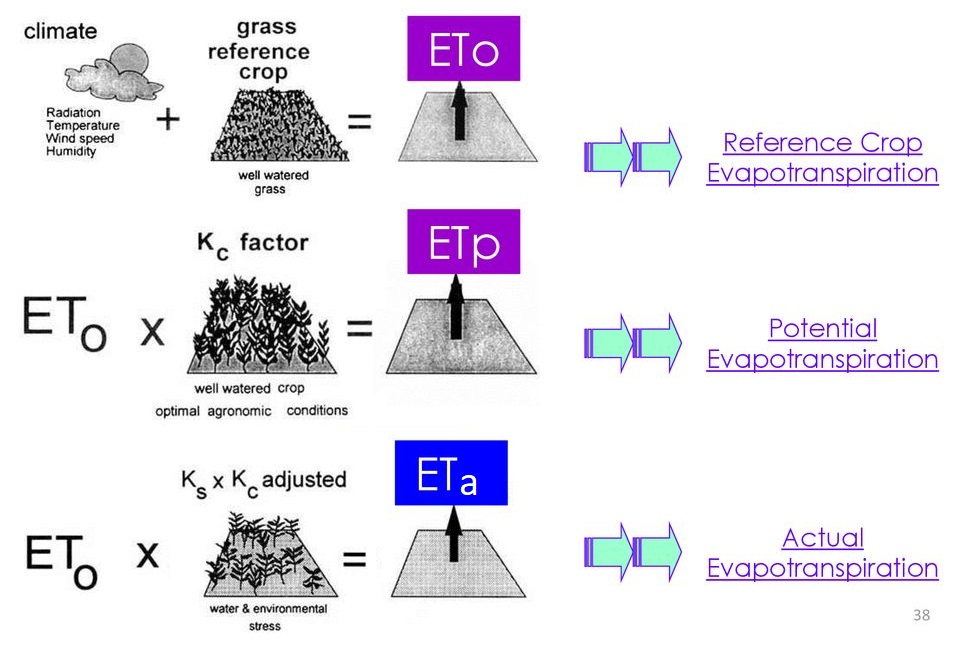
Figure from https://slideplayer.com/slide/16104877/
WaPOR dataset provides RET for consistency and allows for Kcadj computations, however, RET has nothing to do with the derivation of the AETI product.
Advanced clarification
There are other irrigation performance indicators, such as adequacy of irrigation supply, that are based on the ratio of ETa to ETp. Those indicators are beyond this course, as they do not take productivity into account.
Reading task:
Please, go through sub-section 2.1.5 Evaporation, transpiration and interception (raw pdf pp 33-41, document pp 21-29) and 2.1.8 Reference ET (raw pdf pp 49-52, document pp 37-40) of the WaPOR v2 methodology.
Answer the following question:
- Do you have all the necessary information to reproduce the PM equation used by WaPOR?
- how is net radiation partitioned between soil and vegetation canopy?
- how is the evaporation of intercepted precipitation ("interception") computed?
- what is the difference in computations of surface resistance for soil and for the vegetation canopy?
- is there any difference in the aerodynamic resistance computation for soil and for the vegetation canopy?
- how is ET converted from energy (net radiation, W m-2) to matter (mm) units?